

Why It Matters That Spider-Man: Brand New Day Returns to Friendly Neighborhood Roots
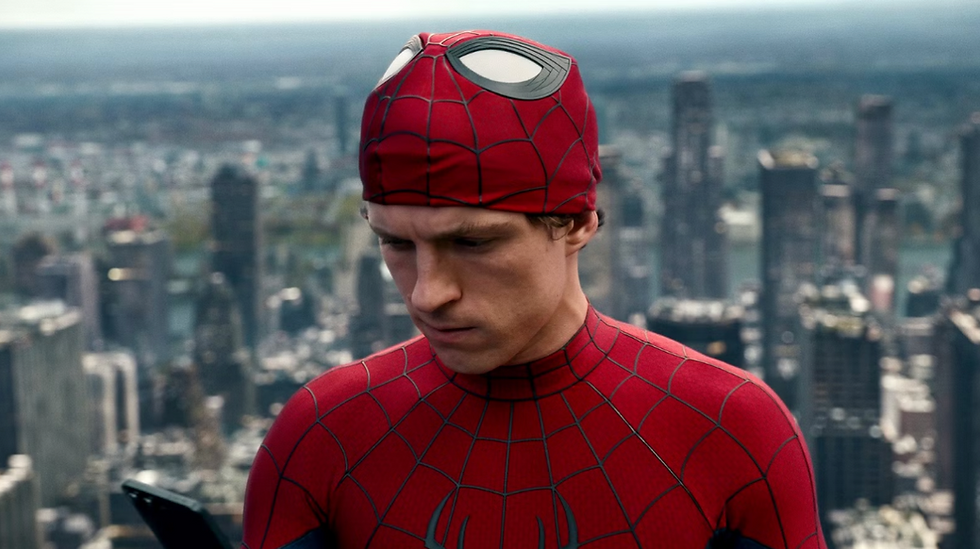
Tom Holland's performance of Spider-Man in Brand New Day marks a return to the moral philosophy that defines the character (Sony Pictures, 2026)
The canon event of every Spider-Man starts in the same place. And no, it’s not when a radioactive spider gives him a life changing bite.
Peter Parker had yet to discover his true identity, using his newfound powers to showboat his superior strength and earn money off a series of wrestling matches. Spider-Man was born in an alleyway, face-to-face with the killer of his uncle. The gunshot of a single burglar meant the difference between a world without his late Uncle Ben, a world without its Spider-Man. In Peter Parker’s grief-stricken memory of Uncle Ben’s final words, Spider-Man’s philosophy was born: “With great power comes great responsibility.”
The scrappy teenaged superhero from Queens becoming the model of responsibility, immortalized in film, television shows, and even a Supreme Court case, is likely not what creator Stan Lee envisioned when pen first met paper. Yet, the character has continually resonated with fans. After all, Spider-Man’s biggest foes aren’t Doc Ock or Green Goblin. It’s his overbearing boss at the Daily Bugle who underpays him while he works double-shifts, his friends who struggle to understand the sacrifices he makes, and a scrutinizing press that dubs him the “Spider-Menace.” Like most of his readers, Peter Parker makes difficult decisions and sacrifices out of the public eye, silently carrying the weight of responsibility. He is the quintessential underdog: always down on his luck, with every reason to call it quits on the superhero game for a more comfortable lifestyle, but still always choosing to show up to protect the city and people that he loves.
Spider-Man is not a power fantasy, but one of moral integrity. Even under scrutiny or indifference, Spider-Man listens to his moral conscience. Part of the reason that makes the “friendly neighborhood” Spider-Man so endearing is its overarching idea that everyone, even an average teenager like Peter Parker, has a responsibility to make a difference in their communities. The Spider-Man franchise famously proclaims that “anyone can wear the mask,” demonstrating the power to use our talents to act heroically is a choice, not something defined by an institutional authority.
The Marvel Cinematic Universe (MCU) has taken a different stance. With the Department of Defense openly funding at least six Marvel films, the franchise has a history of glorifying the military industrial complex and American military interventionism abroad. Instead of rooting their actions in moral accountability, the Avengers oftentimes use their enhanced powers as a legitimization for intervening in global conflict.
The franchise repeatedly codes American-aligned actors as morally justified. The fictional counterterrorism agency S.H.I.E.L.D., for example, operates in an authoritarian style, acting as a supranational security apparatus meant to find and neutralize global threats. However, they go largely unquestioned by in-universe characters because they are framed as the “good guys.” In the Sokovia Accords storyline from Captain America: Civil War, international oversight through the United Nations is rejected by Captain America. Although this defiance involves significant collateral damage, the film portrays his resistance as “principled conviction” rather than “problematic autonomy.”
Captain America personifies American exceptionalism, a belief that the United States abides by a distinctly exemplary model for the rest of the world to follow. America’s veto power as a permanent member on the United Nations Security Council is a direct result from this principle. In 2025, the United States was the only country to vote against the resolution on the Gaza ceasefire, thereby undemocratically blocking the majority opinion. Across both fiction and reality, intervention is often justified not by universal agreement, but by the identity of the actor performing it.

Tony Stark, the billionaire defense contractor behind Iron Man, most clearly embodies these critiques. Whether through illusion-producing combat drones or the creation of Ultron, Stark habitually weaponizes his intellect and innovation. His actions reinforce the idea that heroism is tied to dominance and authority. In the MCU’s version of Spider-Man, Peter Parker is taken under the wing of Tony Stark, eager to join the prestigious ranks of the Avengers. At this point, Parker is nothing more than the aspiring wrestler in his origin story, still trying to prove himself through power rather than understanding what that power requires of him.
He’s not alone in that. Real-world defense contractors mimic the rhetoric of Stark Industries by attracting young engineers and scientists through prestige and cutting-edge technology to distract from their direct participation in systems of violence and conflict.
This time, Spider-Man was not born in an alleyway. He was born in outer space, following the death of Tony Stark. Stripped of mentorship, the mythology of the Avengers, and a world that no longer remembers him, Peter Parker is left with nothing but his own abilities. There are no Avengers to aspire to, no looming existential war to define him. All he has is powers to shoot webs from his wrist—and the question of what that power demands.
Brand New Day promises that his story is only beginning. No longer chasing validation from Tony Stark, Spider-Man returns to his roots as a “friendly neighborhood” hero. The MCU has a unique opportunity to deliver a changed rhetoric on American militarism and power.
Today, expanding American military intervention abroad has led to rising problems in our own neighborhoods, such as surging oil prices from the war on Iran, rising consumer costs, and weakening public support. While American (and Marvel) rhetoric has rested on the premise that military superiority gives us the responsibility to intervene where foreign powers fail, Spider-Man shows us that the responsibility of hero begins in the commitment to care for what is already within our reach. His neighborhood heroism is defined not by how far his influence extends, but by how he consistently shows up for the people in his own community when they need it.
As a beloved American franchise, Marvel has the ability to shape what heroism looks like in popular imagination. Brand New Day opens the door for stories of real communities that need heroes. This new chapter of Marvel can end the glorification of military power that overlooks problems at home and inspire real, homegrown change.
Ho letto questo testo con molto interesse e ho trovato diversi spunti utili. I vari aspetti dell'argomento vengono trattati con la giusta profondità. Ho riletto alcune parti più volte per assicurarmi di aver capito bene. Di solito non è semplice trovare informazioni così ben organizzate su questo tema.
phenomenal article! the real heroes are the people who help their communities, not the ones who exercise an imperial monopoly on military power and also kill people on the reg.