

The Weight of Transcendence: Survival and Pilgrimage in Sirat
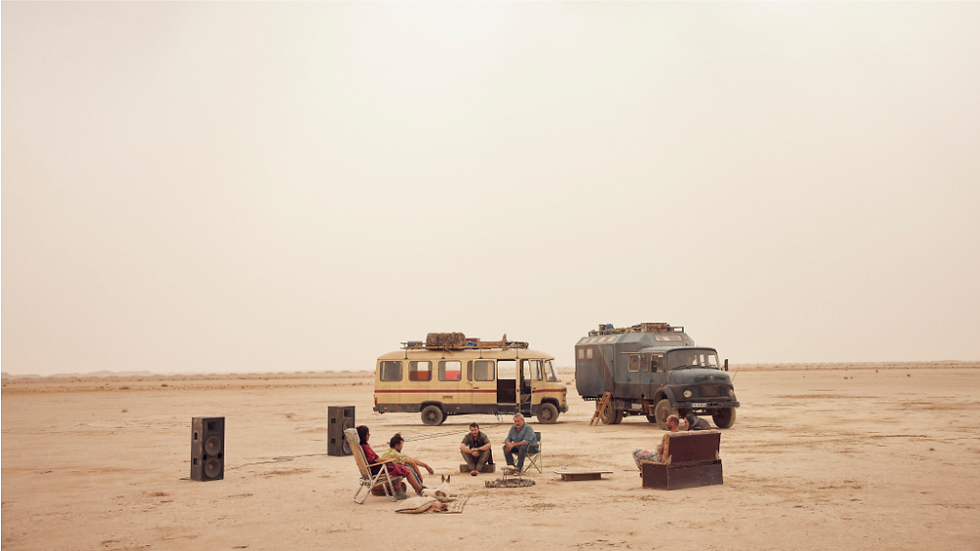
Oliver Laxe’s Sirat is a survival story about several unlikely traveling companions making their way through the Sahara Desert. In a world that is falling apart, the film follows a group of Europeans who treat a dangerous landscape as a playground for spiritual and sensory liberation. By weaving together the energies of a desert rave with the religious symbolism of a pilgrimage, Laxe creates a film that is less of a narrative and more a test of endurance, suggesting that true transcendence requires the shedding of ego, privilege, and eventually, one’s own safety.
The experience begins in Morocco, where hundreds of nomadic Europeans have gathered in the desert for a rave. Sirat is immediately established as a visually and sonically overwhelming experience; it is full of desolate, immersive visuals of the Sahara and propelled by a pulsating score. The film opens with a sequence of hands setting up speakers, the bass thumping across the rock formations, dancers bouncing and swaying to the music. There is almost no dialogue for the first fifteen minutes, laying the foundation for Laxe’s evocative use of imagery and sound. But beneath the music and movement, there is an inescapable sense of dread.

The rave is soon shut down by military officials ordering a mandatory evacuation. Amid the chaos, five ravers drive off in rebellion, bound for another rave further south. Luis and Esteban, a father and son pair, impulsively drive after them in the hope of finding Esteban’s missing daughter, Mar. As they descend deeper into the desert, news trickles in through the radio of a world unraveling: the beginnings of a global war. The characters are surrounded by a heavily militarized environment, yet they ignore the impending destruction. These ravers march into the middle of nothingness like the blind, surrounded by ruin, just to chase a few fleeting moments of ecstasy. This pursuit shows the uncomfortable truth of their privilege. These European ravers, in a country that isn’t their own, defy military warnings meant to protect them, chasing transcendence in a landscape marked by minefields, displacement, and a violent history. In doing so, they echo a long tradition of Westerners treating North Africa and West Asia as an escape from industrial life—an idealized, “unrestrained” existence that clashes with the realities of these regions.
This dynamic lies at the heart of Palestinian-American scholar Edward Said’s Orientalism , which argues that the West has long constructed these regions—grouped together as the “Orient”—as a romanticized “other.” Writers such as Gustave Flaubert and T.E. Lawrence often depicted them as timeless, sensual, and spiritually pure, a contrast to the perceived rigidity of industrialized Europe. Within this framework, the “Orient” becomes a stage on which Westerners act out fantasies of freedom or lack of restraint that were prohibited in their own societies. This fantasy ignores the actual political, social, and economic complexities of the people who live there. When those realities assert themselves—through resistance, modernization, or political agency—they shatter the West's false image of the region, much like how the travelers in Sirat had their own illusions continue to shatter as the movie progressed.
The film doesn't let the travelers off the hook, but it still treats them as real people rather than one-dimensional stereotypes. It holds their grief, longing for freedom, and recklessness, allowing these qualities to coexist in a way that feels uncomfortably, recognizably human.
At first, it almost feels absurd to ask: Is all this just for a rave? But the film soon makes it clear that this journey is something closer to a pilgrimage. Even the title, Sirat, refers to “the bridge” in Islam, described as being “as thin as a hair and as sharp as a sword.” According to the Qur’an, only the “lightest” souls, those stripped of ego and sin, can cross. This is reflected in Luis, who after losing his car, his belongings, and his children, is eventually cleansed by grief and becomes “light” enough to walk through a minefield. The journey turns into a Hajj, a march toward a paradise, that may just lead to death. As the film suggests, you have to cross hell to get to heaven.

Watching Sirat is a brilliant yet harrowing experience. In moments when everything goes wrong, there is a physical urge to leave the theater. Just when you think things are going to get better, the horror returns, until you almost become numb to the relentless tragedy. In the final sequence, we see the three surviving travelers on a train with other refugees; for the ravers, the party is finally over. They are forced to join the broader struggle of those uprooted by the system—a conflict that now impacts everyone, everywhere. By the end, Sirat tells the viewer to stop trying to make sense of the world and instead feel your way through it, much like a rave itself. You may not leave the film understanding it, but you may feel like you’ve survived it.
Comments