

Fortunes of a Fairytale: How Fiction Shapes Our Society

Fairytales may help children fall asleep at night, but they are more significant than bedtime entertainment; they are more like capsules for cultural values. In the case of Shahrazad, they saved her life. The storyteller of the 1,001 Nights, Shahrazad, tells 1,000 stories, one each night, to delay her husband from killing her. One of these stories includes the renowned classic “Aladdin,” a story that teaches the importance of being mindful of what you wish for as well as introducing cultural aspects to a wider audience – like the myth of the genie in the lamp – of the Middle East. 1,001 Nights is an example of how oral storytelling is intimate and a part of the reason why fairy tales are still so beloved, even on pages.
Cinderella may be the most well-known story around the world. The moral of the story is that ethically good people do get their happy ending eventually, despite external setbacks. This story is also the reason “Cinderella Syndrome” has a name. People, particularly women, can have a fear of independence and ensnare themselves in codependent relationships because they believe someone else can “save” them, as the prince saves Cinderella. Then, it’s easier to believe beautiful people are good people when that’s who always wins. After all, Cinderella’s ugly stepsisters are customarily ugly inside and out. People can debate whether or not pretty privilege exists, but it’s no secret that conventionally attractive people are persistently treated better than those who are not. Meanwhile, villains are often portrayed with undesirable physical traits and sometimes even disabilities in our media, implying that their physical traits are what make them evil.
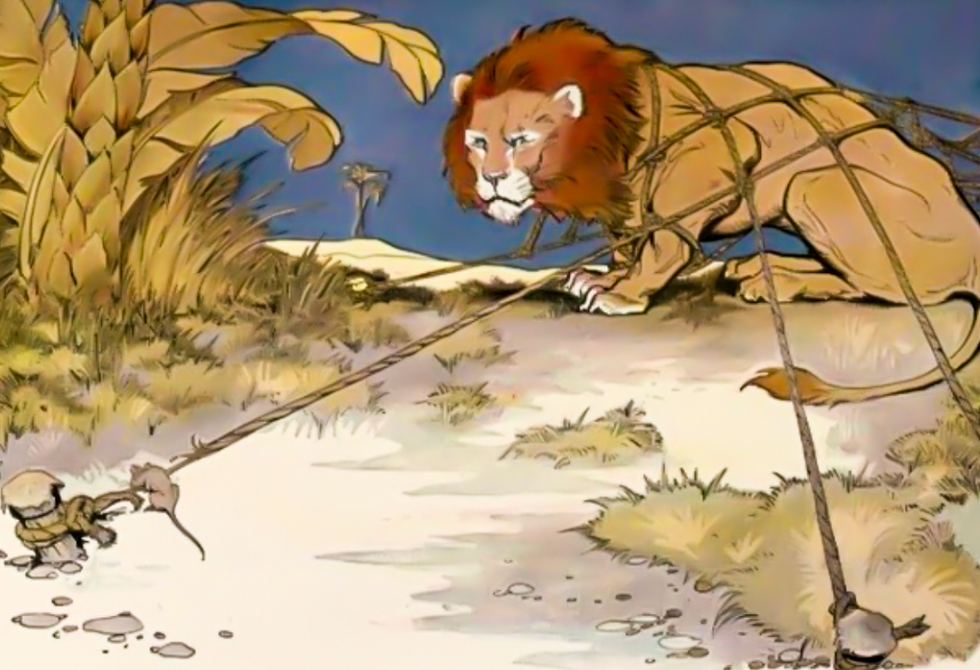
Human beings have always been curious creatures, but before they could do empirical research all they could do is wonder. Stories about why the crocodile’s skin is bumpy or how the rabbit lost its tail, both from Native American tradition, were some of our initial theories about the world around us. These stories also help us to understand each other and our relationships. Aesop’s fable The Lion and the Mouse teaches us that people who are at the bottom of the social power structure still have an impact on those who are at the top. The lion spares the mouse's life and laughs when the mouse says he could return the favor, but the mouse is able to save him from a hunter’s net. Similarly, large corporations seem to have most of the economic power, but the consumers still have their role to play to keep these corporations afloat; that’s why boycotts are so impactful. Everyone needs each other one way or another.
The Brothers Grimm are notorious for creating most of modern folklore with a more refined focus on realism. Their stories were created for both children and adults. Popular stories include “The Little Red Riding Hood” and “Sleeping Beauty,” which helped to preserve Germanic traditions and pre-Christian mythology. The Brothers Grimm and other writers like Hans Christian Andersen wrote stories that stepped away from happy endings. In many of their tales they strived for less happier endings. Andersen’s story “The Little Mermaid” ends more symbolically with the little mermaid being able to travel the world as a wind spirit rather than a human. She doesn’t get saved by the prince as she does in the Disney movie, but achieves a more fulfilling ending. Beyond the moral lessons, these tales inspire further creativity and storytelling. The many renditions prove that such a simple plot structure leaves plenty of room for adaptation.
Disney has created most of its franchise out of rewriting fairytales. Their latest live action movie, Snow White (2025), was meant to change some of the less than empowering themes common in their older films. Although some would say that this was a cold cash grab, it can’t go unsaid that Disney made these retellings popular. “Once Upon A Time” was a hit show– before it delved into Disney advertisement– which expanded upon childhood classics with more mature themes for its older audience. The best thing about a retelling or adaptation is that there is a chance to create something new, represent another culture, gender identity, and introduce more modern ideologies.
Most of the fairytales in the mainstream do have Western influences. The purpose of these stories is to preserve culture. There could be even more of an impact if there were more stories from different cultures. Chimamanda Ngozi Adichie authored “The Dangers of a Single Story,” which entails that when only a single narrative is propagated in the mainstream, it creates close-mindedness. During the Transatlantic Slave Trade, displaced Africans kept some of their traditions by passing down oral stories. They brought us the tales of Br’er Rabbit and Br’er Bear that are less well-known but just as important to American culture. It regals the perseverance of African Americans and Black Vernacular English. BVE is often displaced and not respected as the dialect that it is. The purpose of a fairy tale is to preserve culture, and for this reason, more fairytales should be preserved as we enter a more globalized world.
Comments