

Babel: The Implications of Literary Translation
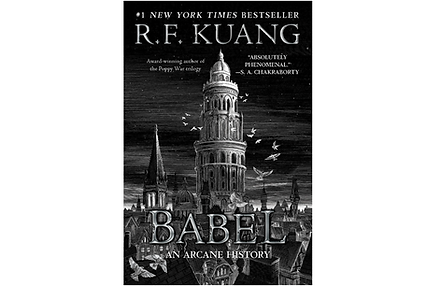
The Cover of Babel
“Translation means doing violence upon the original, means warping and distorting it for foreign, unintended eyes. So then where does that leave us? How can we conclude, except by acknowledging that an act of translation is then necessarily always an act of betrayal?”
-R. F. Kuang, Babel
In her 2022 epic historical fantasy novel Babel, or The Necessity of Violence, R. F. Kuang explores the intersection of colonialism, language, translation, and racism, among other themes.
The narrative follows Robin Swift, a Cantonese boy trained in England to be a translator, as he begins his studies at Oxford University and meets fellow foreign-born students. Slowly, he realizes they are all being trained to exploit their native languages for the benefit of the British Empire and discovers an underground society of translators working against the empire’s colonialism.
Many readers view translation as a neutral, unbiased practice. In reality, it is much more complicated. In a 2020 Oxford University Press article about the politics of translation, communication scholar Elaine Hsieh writes that often “translations are viewed as reproductions of the source text rather than the product of a collaboration (conscious or not) between the translators, the author, and the readers.” Rather than converting a text 1:1 from one language into another, no matter how skilled or intentional the translator is, translators are tasked with making countless choices about how to maintain a text’s message. In Babel, fantastical power is created and harnessed by inscribing words of different languages with similar meanings onto bars of silver, and the slight differences in definition or interpretation—the meanings lost in the process of translation—create a unique energy that has magical effects.
Though this is obviously an extremely fictionalized perspective on translation, it does reflect truer themes about the practice. Language is a mode of consciousness, symbols used to communicate thoughts and experiences between people. Thus, when a word is translated between two languages, the way the idea itself exists is changed. Language is deeply rooted in geographical history and culture, which gives words meanings that cannot always be fully conveyed across languages. There are words and turns of phrase that have no counterparts in other languages, so inherently, there can be no completely accurate direct translation between languages. While interlingual communication is not impossible, it is often a vessel for unconscious and unavoidable political implications.
This then leads to the question of how translation can influence international communications and culture. Literary translation is a particularly interesting case. It serves as a unique puzzle for translators, who must balance prioritizing figurative language, the flow of speech, and overarching themes.
“The translator needs to be translator, literary critic, and poet all at once—he must read the original well enough to understand all the machinery at play, to convey its meaning with as much accuracy as possible, then rearrange the translated meaning into an aesthetically pleasing structure in the target language that, by his judgment, matches the original” (Kuang 147-148).
In Babel, Kuang explores the concept of literary translations infused with domestic illustrations and thus stripped of their original cultural meanings. She touches on the real-life example of Alexander Pope’s translation of The Iliad, which Pope injects “with so many Britishisms that he makes Homer sound like an eighteenth-century English aristocrat” (Kuang 152). Pope, though a highly regarded writer, proved with this translation the significance of language in storytelling. His translation ultimately becomes a version of a retelling stripped of its original Greek cultural storytelling, as is easily done with any literary translation.
The idea that translation is able to erase cultural meaning and perpetuate dominant narratives contributes to the concept of language as a tool for colonialism. Language scholars widely consider English an imperial language, especially between the 16th and 20th centuries (and its continued dominance into the modern day may implicate it further). With the presence of a dominant language backed by military and financial power, the British Empire was able to wage war, enslave people, and control global resources. Britain, like any dominant imperial presence, villainized and/or inferiorized non-dominant language speakers simply because they had no way to combat such narratives to English speakers, and quickly became outnumbered. The use of language to “other” certain groups also directly correlates with and contributes to racism and the marginalization of immigrants and foreigners.
Literary translation barely touches the surface-level implications of language as a source of power and shaper of knowledge. There are over 7,000 languages alive today, each offering a unique perspective on the world and the way its speakers engage with it.
However, aside from its harsher colonial effects, translation can also be an art form and a powerful facet of communication between people of different languages. “While early studies of the impact of translation centered on the use of translation in enforcing and imposing the hierarchical superiority and worldview of a dominant culture onto the colonized, recent studies have also argued that translations can be a form of resistance and activism,” reports Oxford Research Encyclopedias. Even Kuang agrees with Oxford on this point, despite her characters fighting to take down the institution from the inside in Babel.
Comments